

In 2023, Black Sea Petroleum launched the construction of the first full-cycle oil refinery in Georgia.
In our journalistic investigation, we will expose the ties of the refinery in Kulevi and Black Sea Petroleum to Russia’s special services, Russian business, and the Georgian authorities, and how the Kulevi oil refinery is being built using products of Russian companies under international sanctions.
The Kulevi Oil Refinery: a dangerous partnership with Russia and major sanctions risk
In 2025, Georgia’s oil-product export reached its historical highest. Last fall, Georgia purchased 225,000 tons of crude oil from Russia for 95.6 million USD. This raw material was processed in our territory. Consequently, Georgia exported a record-breaking amount, over 151,000 tons, of “Georgian” oil product. It was further resold in Malta, Gibraltar, and the United Arab Emirates, establishing Georgia as its “country of origin.” The revenue from these sales made up 80 million USD.
This drastic increase in the export of “Georgian” oil products chronologically coincides with the construction of a refinery in Kulevi, with the state’s participation.
Who’s who in the “Kulevi project”?
Black Sea Petroleum has been granted 600,000 m2 in a free economic zone near Kolkheti National Park and a permit to build a factory. Formally, the company is represented by Maka Asatiani, a former model and designer. She is the daughter of Kakhi Asatiani, a former soccer star for Dinamo Tbilisi and businessman murdered in 2002.
At the project’s mega-presentation in the fall of 2024, Asatiani sat next to Irakli Kobakhidze, thanking the Georgian Dream government for “unprecedented support.” However, our journalistic investigation focuses on other “distinguished” figures, those remaining in the shadows.
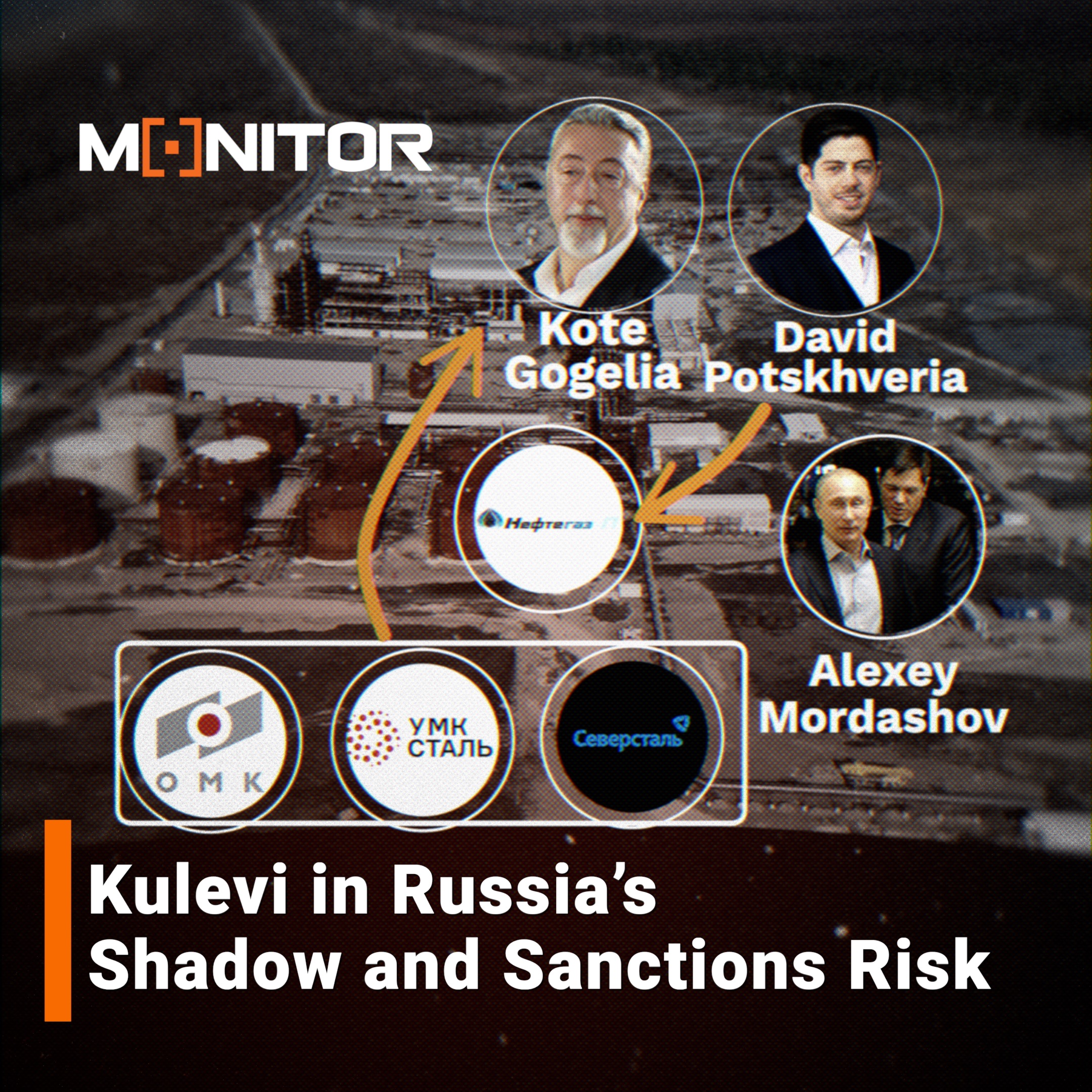
Kote Gogelia, Maka Asatiani’s husband, is the one who actually runs the project. A Russia-based businessman of Georgian descent, he has been operating in Russia’s oil trade and railroad shipments since the 2000s. His political past is diverse: Gogelia was one of the leaders and donors of the Georgian Party in 2011, among others.
However, what is especially noteworthy is that, in 2011, the Georgian Party declared any relations with Kote Gogelia “totally unacceptable in light of the principles of political ethics.”
Davit Potskhveria, Kote Gogelia’s sororal nephew. In February 2025, he became a Black Sea Petroleum shareholder. Since September 2025, he has been the company’s general director.
Mikheil Chkuaseli, another director of the refinery and former finance minister back from Shevardnadze’s era.
Presently, Black Sea Petroleum’s 70.66% is owned by MK Capital, Maka Asatiani’s company. The remaining 29.34% is owned by Davit Potskhveria’s company, Dunami.
The role of Levan Davitashvili in this matter deserves special mention. Some 16 months ago, he, as Georgian Dream’s economy minister, oversaw the project from the state’s side. However, after resigning, he reemerged as the chairman—that is, “overseer”—of the Black Sea Petroleum supervisory board.
Behind this scheme, developed in the name of “energy security,” we discern the presence of the Development Fund of Georgia and three commercial banks, including Cartubank, also persons associated with Russian business.
The following is how Vakhtang Partsvania, PhD in Economics and professor of Caucasus University, assesses the project in economic terms.
“The commercial logic of the Kulevi refinery is compatible with Russian crude oil supply. Geography and economics both point in the Russian direction”.
Investors: rubles, a state foundation, and commercial banks
Georgian Dream’s Prime Minister Kobakhidze has referred to the construction of the Kulevi Refinery as “the largest private investment project in the history of independent Georgia.” For the first stage of the project evaluated at 700 million USD, about 110 million USD was spent.
But where does this money come from? There are three main sources of financing, with a Russian footprint and Georgia’s state interests interwoven.
In 2025, when Kote Gogelia’s nephew, Davit Potskhveria, became the owner of 29.34% of the Black Sea Petroleum shares and its general director, he replenished the company’s capital with 911 million Russian rubles, i.e. about 31.7 million GEL.
Davit Potskhveria would not answer Monitor’s questions about Russian ties and finances.
Three banks issued a credit worth 45 million euros for construction: Cartu, a bank founded by Bidzina Ivanishvili, the Chinese Basis Bank, and Kazakh Halyk Bank.
One of the project’s investors is the state itself, represented by the Development Fund of Georgia, the former Partnership Fund. The fund invested a loan worth 5.7 million USD at first, later increasing its input to 8.2 million USD.
The government has classified the explanatory note attached to the prime minister’s relevant decree. This note justifies the fund’s investment in the oil refinery.
Why did the government decide to become involved in the construction of an oil refinery in Kulevi in the first place? The government of Georgia has left this question unanswered.
Presently, all 100% of Black Sea Petroleum, along with its movable and immovable property, is hocked as security for a 30-year, 50-million-USD loan.
The relevant lien agreement was signed between Black Sea Petroleum, commercial banks, and the state fund.
Gogelia: ties to the Kremlin, crime, and FSB
Synchronizing with the Kremlin’s elite marked the beginning of Gogelia’s path in Russia’s energy sector.
Gogelia owned at least seven large companies in Russia, also enjoying revenues from several oil rigs. According to a journalistic investigation by Vedomosti, a Russian publication, his Swiss company, Progerta, became involved in Sibneft (presently Gazprom Neft) oil export in 2004. One of Kote Gogelia’s main assets, “Severnaya Gruzovaya Kompaniya” (Northern Freight Company), where the formal owner was Maka Asatiani’s offshore company, became the exclusive partner of Gazpromtrans in 2010.
The Russian publication further relates that behind this success stood Valery Golubev, Putin’s old friend and colleague from the KGB. In 2006, the dictator appointed Golubev as Gazprom’s chairman. Russian media outlets assert that it was Golubev’s patronage that opened the doors of state monopoly for Gogelia—a business environment of major magnitude where “occasional people” never make it without the Kremlin’s consent.
Gogelia’s ties lead to the Russian defense ministry as well. According to information circulating through the Russian media, his name appeared in the 2012 criminal case against Defense Minister Anatoly Serdyukov’s team.
According to the relevant investigation, Gogelia’s company turned to corruption and appropriated, for half the price, an oil terminal in Murmansk that previously served the Russian Northern Fleet’s naval intelligence. Still, thanks to political backing, he was never brought to justice. Gogelia’s ties to special services become even clearer in Kaluga Oblast. According to iStories, a Russian investigative media outlet, Gogelia ran the local refinery in tight cooperation with the family of Valery Bitaev, a figure closely associated with the Federal Security Service of the Russian Federation (FSB). In 2022 alone, the refinery’s profit made up 529 million USD.
Presently, Kote Gogelia does not register companies to his name. However, Monitori has gained access to documents proving that he remains behind the companies linked to him in the past and still operating.
These include one of his main assets, Oil Energy Group (OEG), registered to the name of Kakhi Zhordania, Maka Asatiani’s son, until 2023. Linked to Kote Gogelia, this company—before the construction of the refinery in Kulevi—intended to build a bitumen terminal in Oryol Oblast, Russia. This plan, however, never came to fruition.
Neftgaz L: trading with sanctioned Russian giants
Neftgaz L, a Russia-based company, is in the epicenter of the Kulevi project’s financial and logistics operations. From 2019 until December 2025, Davit Potskhveria owned 100% of the company’s stock. At the same time, he was Georgian Black Sea Petroleum’s general director and co-owner. Before the launch of this investigation by Monitori, Davit Potskhveria reregistered this joint-stock company to the name of Invest Group, a firm whose ultimate owner remains unknown to the public.
As a war broke out in Ukraine, the net profit of Neftgaz L skyrocketed, increasing tenfold to constitute 845,550,000 rubles (30 million GEL) in 2023.
Documents obtained by Monitori expose a scheme, as part of which Neftgaz L, a Russian company, procures all equipment and materials necessary for the Kulevi Refinery in Russia.
Monitori has also acquired a document showing that the relevant sanctions apply to at least three companies selling building materials to Neftgaz L for Black Sea Petroleum. These include Severstal, a firm owned by billionaire Alexei Mordashov, Putin’s close friend. Both the company and its owner are under severe US and EU sanctions.
UMK Stal and OMK, Russian metallurgical giants, are also sanctioned by the US. Despite these international restrictions, however, these very companies supply building materials for the construction of the refinery in Kulevi.
Black Sea Petroleum refuses to answer our questions about trading with the sanctioned company above.
The scope of imports from Russia is so large that, in 2024-2025, Black Sea Petroleum became the top ten list of importers to Georgia.
According to Giorgi Muchaidze, a security policy expert, carrying out joint energy projects with an occupant state goes against Georgia’s national interests.
“Unfortunately, given Ivanishvili’s state capture, with his actions betraying Russian signature style and Moscow’s influence, it comes as no surprise that state institutions act in his personal and not national interests,” Giorgi Muchaidze asserts.
The trace of a GRU general in the Kulevi project
On February 6, 2026, General Vladimir Alekseyev, first deputy head of the Main Directorate of the General Staff of the Russian Armed Forces (GRU), was shot multiple times in the capital of Russia. Sanctioned by the US, the UK, and the EU, Alekseyev has survived but remains in a coma. He was sanctioned as early as 2018, for “orchestrating the poisoning of Sergei Skripal and his daughter with Novichok.”
GRU General Alekseyev’s traces lead all the way to the Kulevi Oil Refinery.
According to Proekt, one of the most authoritative investigative platforms in Russia, a mammoth business empire—formally registered to relatives and authorized agents—stands behind the façade of “Russia’s hero, General Alekseyev.” The general’s son eventually became a primary link to the activities related to oil and oil-product logistics. The outlet publicizes evidence proving a business partnership between Sergey Alekseyev, Vladimir Alekseyev’s son, and Kakhi Zhordania, Maka Asatiani’s son from her first marriage.
Documents obtained by Monitori reveal that Davit Potskhveria, Kote Gogelia’s sororal nephew and one of the Kulevi project’s key actors, has been affiliated with this group for years. Davit Potskhveria and the son of the GRU general were business partners for 5 years.
Potskhveria’s company, Neftgas L, is the main contractor of Black Sea Group, also owning shares in SDO Energo until the spring of 2025. According to the archive of the Federal Registration Service of Russia, Potskhveria’s partner in this business was SDO Logistic, a company whose 51% of shares belonged to Sergey Alekseyev, son of General Vladimir Alekseyev, while 25% of the stock was owned by Kakhi Zhordania.
Human resources from Russia and Russian as a working language
As the Kulevi project was about to kick off, Georgian Dream’s government promised the public to employ 500 people in the future oil refinery. Reality, however, is somewhat different. Black Sea Petroleum, acting through its Russian contractor, Neftgas L, seeks qualified human resources in Russia and Central Asia.
A list of openings in Russia’s labor market sets forth conditions for labor force to be employed in Georgia, including 190,000 rubles (about 6,700 GEL) per month, also free food and accommodation, and two-way transportation from Russia to Georgia. For the most part, these job offers target hi-tech steamfitters.
According to Monitori’s source, tens of Russian citizens are presently employed at the Kulevi construction site. Still, the search for qualified human resources continues in the countries of the CIS and the Persian Gulf.
The company held employment campaigns in Georgia as well. Still, Russian influence remains decisive here too, with fluent Russian listed as a mandatory requirement.
Worse still, the duties and obligations section directly emphasizes working with Russian-language documents, in this way reaffirming that the entire system of the refinery’s management and engineering is shaped to fit Russian standards and human resources.
Monitori officially addressed Black Sea Petroleum with the following questions: How many people are presently employed at the refinery? How many Georgian and Russian citizens? Why is fluent Russian mandatory at a Georgian site? The company left these questions unanswered.
A hub for processing Russian oil?
On October 6, 2025, the Kulevi Oil Refinery received the inaugural batch of crude oil, some 105,000 tons, from Russia’s Novorossiysk Port. Notably, this information was disseminated by the international news agency Reuters, not the Georgian side.
Transported to the port of Kulevi, this unprocessed material belonged to Russneft, a Russian oil company owned by Mikhail Gutseriev, a sanctioned billionaire. In 2012, Gutseriev paid 982.5 million USD to Ivanishvili as the letter set out selling his Russian assets in order to engage in Georgian politics.
Even though Georgian Dream insists on scrupulously observing international sanctions, experts discern textbook signs of sanctions circumvention in Kulevi. Heading from Russia’s ports, these oil tankers are suspected by Ukraine’s intelligence and the International Maritime Institute to have been involved in the following questionable activities:
Dark Voyages: Russian tankers turn off the AIS system in order for their routes to remain undetected.
Ship-to-Ship (STS) transfers: Transferring cargo from one tanker to another on the open sea in order to conceal the actual origin of crude oil.
Shadow fleet: Full of crude oil, some of the tankers entering Kulevi are registered offshore or in Arab states, and they are operating without Western insurance and bank guarantees.
“Tankers traveling between Russian and Georgian ports that disable AIS is a pattern widely associated with “shadow fleet” tactics. These practices are used to reduce visibility, obscure routing, and complicate sanctions monitoring.” Professor Vakhtang Partsvania emphasizes.
One of the examples of this scheme is the Russian tanker Truvor (IMO 9676230) that entered Kulevi on December 19, 2025. Maritime platforms confirm that this ship under the Russian flag had its signal turned off for days.
Truvor made the US black list as early as 2019, for shipping oil to the pro-Russian regime of Bashar al-Assad, Syria’s dictator. The Maritime Transport of Georgia informed Monitori that the tanker was not sanctioned, and its transit cargo, oil, was intended for Armenia.
The version above is refuted by SOCAR, an Azerbaijani company that owns the port of Kulevi, confirming instead that, in reality, the oil was received by Black Sea Petroleum.
A project tailored to suit Russia’s interests
For years, building an oil refinery in Kulevi was considered a death march. As early as 2012, the Georgian government pitched it to SOCAR, an Azerbaijani energy giant that has owned the port of Kulevi since 2006. In 2016, however, the Azerbaijani side officially rejected the project as cost-ineffective.
In 2016-2023, another investor, Phasis Oil, could not “resuscitate” the Kulevi project either.
The foregoing gives rise to the following question. Why does a twice-failed and cost-ineffective project become attractive all of sudden in 2023? According to experts, the answer lies in the war in Ukraine and the sanctions imposed on Russia.
In a conversation with Monitori, Vakhtang Partsvania, professor of Caucasus University, says, “ The project was initiated at a moment when EU sanctions did not yet prohibit imports of petroleum products refined in third countries from Russian crude. During this period, countries such as India, China, and Turkey imported large volumes of discounted Russian crude oil, refined it domestically, and exported petroleum products to EU markets under their own country of origin, capturing substantial margins in the process.”
Because of the war in Ukraine, Russia’s oil industry found itself under heavy pressure. A 60 USD per barrel price cap has been enforced, in this way prohibiting the purchase of Russian crude oil for a higher price. Also, Russian oil giants, such as Rosneft, Gazprom Neft, Lukoil, and Transneft, have been sanctioned. Thus, purchasing products from these companies is now prohibited. In addition, because of the attacks of Ukrainian drones in the Black Sea, processing and transporting Russian crude materials has grown quite dangerous and expensive.
Experts suggest that the profit margin per barrel in such schemes is very high.
“Sanctions have created unusually large arbitrage opportunities, which can translate into substantial additional profits for those willing to operate in higher-risk environments,” Vakhtang Partsvania says.
The geopolitical importance of this scheme is discussed by Giorgi Muchaidze, CEO of the Atlantic Council of Georgia.
“Since Ukraine’s invasion by Russia, the latter has turned to a variety of methods to conceal the Russian origin of energy resources and sell them, bypassing sanctions. These include using the so-called shadow fleet for transporting crude oil and processing it in other countries. Naturally, these factors would give a major boost to the cost-effectiveness of an oil refinery near a port in Russia’s neighborhood.”
Russia does not even try to conceal this “strategic alliance.” Rhythm of Eurasia, a publication affiliated with Russia’s Foreign Intelligence Service and Foreign Ministry—also sanctioned by the US—openly publicizes a map with the Georgian oil terminals of Kulevi and Supsa identified as “complementary” to the port of Novorossiysk, Russia.
What awaits the Kulevi Oil Refinery in the wake of the 18th package of sanctions?
The EU continues mounting pressure on Russia’s energy sector as the main sponsor of Putin’s military machinery. According to statistics for 2026, although the Kremlin spends 40% of the federal budget on war, international bans have already cut Russia’s oil revenues by 30-40%.
Brussels has gradually banned the maritime import of Russian crude oil. Still, the 18th package of sanctions is a critical challenge for Georgia. The package entered into force on January 21, 2026, following the decision of the European Council.
These new regulations seek to prevent various mechanisms for circumventing sanctions. Article 3ma of the 18th package clearly prohibits third countries from importing oil products derived from Russian crude materials.
From now on, the EU will demand a so-called chemical passport, i.e., a laboratory report confirming beyond doubt the presence of specific proportions of sulfur and admixtures in the molecular composition of oil from concrete deposits, also ruling out any attempts to label Russian Ural-type oil as “Georgian.”
The first warning signal for Kulevi’s ringleaders sounded as early as the test period, when the Kayseri tanker delivered the first batch of crude oil. The cargo was sent by Russian Russneft. Shortly after this operation, Russneft found itself targeted by international sanctions.
On February 9, Radio Liberty reported that the EU may include the Georgian port of Kulevi in its 20th package of sanctions against Russia. According to the media outlet, the package envisages a ban on transactions with four port terminals in third countries.
And this is how the document justifies the necessity of sanctions: “[The Kulevi Port] is used for the maritime transportation of crude oil or petroleum products that originate in Russia or are exported from Russia by vessels practicing irregular and high-risk shipping practices.”
Prime Minister Irakli Kobakhidze answered our question concerning this matter in the following manner: “Of course, we don’t think that anything falling under the policy on sanctions is happening there.”
Black Sea Petroleum would not answer our questions about the company’s plans in case of sanctioning.
In an interview with Monitori, Professor Vakhtang Partsvania emphasizes an ongoing bipartisan initiative in Congress and growing sanctions risks.
“There is also tariff risk. Under current discussions in the US, a bipartisan bill proposes tariffs of up to 500% on exports from third countries that continue purchasing Russian oil. If adopted, this would dramatically raise the cost of participation in such trade schemes, not only for energy companies, but for the broader export sectors of those countries. And I would remind that Georgian companies exported goods worth $ 120 million to the US in 2025.
“Should facts of possible discrepancies, manipulations, or intentionally withholding the origin be identified and documented, risks will increase dramatically. Consequently, Kulevi or commercial entities linked to it will be sanctioned, much like what happened in the case of Indian Nayara Energy.
“Being sanctioned by the EU entails the loss of access to euro and USD transactions, Western banking channels, security, and trade finance, a factor poised to enforce critical limitations on the functioning of Kulevi’s operator.”
The government of Georgia, the Ministry of Economy, and the Development Fund of Georgia refused to answer Monitor’s questions about the risks and possible repercussions of sanctions announced by the EU.
 Related News